
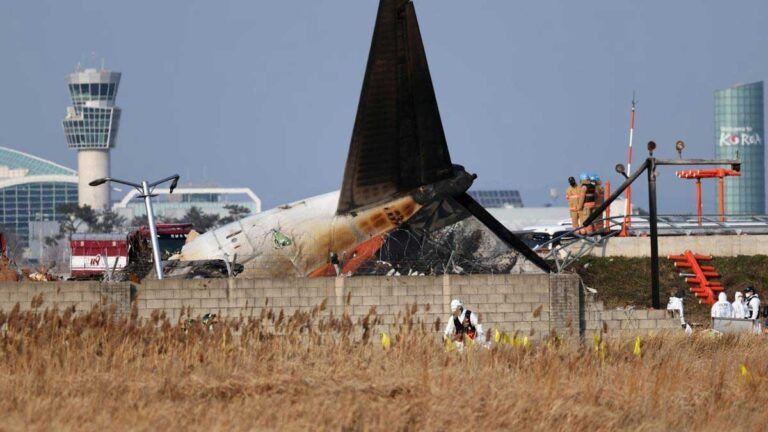
The calm skies over Muan County, South Korea, erupted in chaos early Sunday morning when Jeju Airlines Flight 7C2216 from Bangkok, Thailand, ended in catastrophe. Of the 175 passengers and six crew members aboard, only two miraculously survived, leaving 179 dead in what has become South Korea’s deadliest aviation disaster.
As the clock ticked past 9 a.m. local time, initial reports painted a picture of what could have been a miraculous emergency landing. The aircraft appeared to skillfully glide belly-first along the tarmac, a testament to the pilot’s efforts. But this illusion of control ended brutally as the plane slammed into a concrete embankment and exploded into a fiery inferno.
The footage, now burned into the collective memory of a grieving nation, showed the aircraft engulfed in flames as rescue crews scrambled to extinguish the blaze. For the survivors, their narrow escape was both a miracle and a cruel reminder of the fragility of life.
A Series of Unfortunate Events
The CEO of Jeju Airlines stated that the aircraft had shown no signs of mechanical issues before the flight. Yet, as investigators dig through the wreckage, questions abound. How could such a routine landing go so catastrophically wrong?
According to the Ministry of Land, the tower instructed the pilot to change approach direction to avoid a potential bird strike. This was no idle warning; Muan Airport, nestled amid wetlands teeming with migratory birds, is a hotspot for avian collisions. Statistics show it leads South Korea’s airports—save Incheon International—in bird strikes. Despite efforts to mitigate the risk with repellents and habitat management, the skies above Muan remain a hazardous zone.
Roughly a minute after changing course, the pilot made a desperate emergency call to air traffic control. Two minutes later, disaster struck. Initial findings suggest the landing gear failed to fully deploy, leaving the plane vulnerable during touchdown. But what caused this critical failure? Bird strike? Technical malfunction? A cruel twist of fate?
Concrete Proof of Tragedy
Experts have pointed out another culprit: a concrete structure at the edge of the runway. Officially a «localizer,» it aids navigation during landings. However, this particular installation was mounted atop a pile of earth—a design choice that has drawn sharp criticism.
Former pilot Qing Hang Hil didn’t mince words. «Solid structures have no business being near runways. They’re supposed to crumble or dissipate impact energy. Instead, this one turned a survivable emergency landing into a death sentence.»
Indeed, investigators believe many passengers survived the initial belly landing, only to perish when the aircraft hit the concrete embankment and erupted in flames.
An Airport with a Checkered Past
Muan Airport has long been on aviation experts’ radars—not for accolades but for its alarming bird strike rate. Vice Minister of Aviation Yu Yun Wang assured the public that mitigation measures had been in place, but the statistics tell a grimmer story.
For years, migratory birds have made the wetlands around Muan their seasonal home, turning the skies into a treacherous obstacle course for incoming flights. One aviation journalist noted the bitter irony: «The birds are safer here than the planes.»
Political Fallout
Interim President Sho Sang Mok wasted no time declaring the crash site a «special disaster zone.» Promising a full investigation, he vowed to leave no stone unturned. Yet, critics argue that the incident highlights systemic issues—poor airport design, insufficient bird management strategies, and an over-reliance on aging aviation infrastructure.
Meanwhile, Jeju Airlines faces its darkest hour. The carrier, known for its strong safety record, now grapples with the aftermath of a tragedy that no amount of training or protocols could have entirely prevented.
Gallows Humor in Grim Times
For many South Koreans, the horror of the crash has been tempered by a dose of grim humor—a coping mechanism in times of national grief. One online commentator quipped, «Turns out the only thing harder to land than a plane in Muan is an actual solution to bird strikes.»
But even dark humor cannot obscure the heartache of 179 lives lost. The tragedy has ignited debates on aviation safety, infrastructure design, and the unpredictable forces of nature.
As the smoke clears and investigators piece together the puzzle, one thing is certain: the skies over Muan will never look the same again.