
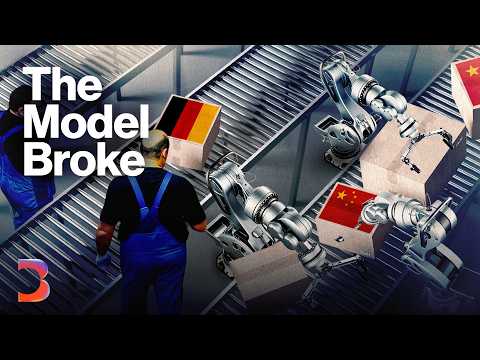
For decades, Germany’s economic formula looked almost irritatingly reliable: build superbly engineered things, sell them around the world, reinvest the proceeds, repeat. Cars, machine tools, chemicals, industrial components—the country made the objects, and often the equipment needed to make the objects. It was less an economy than a very efficient workshop with an export department attached.
That formula is now under serious strain. Germany’s recent weakness is not simply a post-pandemic hangover or a temporary dip in consumer confidence. The pressures are piling up in the parts of the economy that long made the country Europe’s industrial anchor: energy-intensive production, automotive manufacturing, engineering and export supply chains.
Industry accounts for roughly one-fifth of Germany’s total value added, a substantially larger share than in several other major EU economies. When that industrial base slows, the effects do not stay behind factory gates. They reach logistics firms, business services, regional towns, public finances and, eventually, the rest of Europe.
An industrial slowdown years in the making
Germany’s industrial output had a long upward run after labour-market reforms in the early 2000s and recovered strongly following the global financial crisis. Output peaked around 2018, according to the trajectory cited in the reference material. Since then, the sequence has been brutal: pandemic disruption, supply bottlenecks, the energy shock following Russia’s full-scale invasion of Ukraine, weak global demand and increasing trade friction.
The result is a more unsettling question than whether Germany will post a better growth number next year. It is whether part of its industrial capacity has become permanently less competitive.
That distinction matters. A cyclical downturn eventually lifts when demand returns. A structural problem is nastier: businesses invest elsewhere, skilled workers leave, suppliers lose volume and a region can spend years discovering that its old economic map no longer works.
Energy: the cheap-gas era is over
One of the old model’s quiet advantages was access to comparatively cheap Russian gas. Before the rupture in energy relations with Moscow, Russia supplied about half of Germany’s natural-gas demand, according to the video source. That dependency was always a geopolitical gamble; after 2022, the bill arrived with industrial consequences.
Energy costs in Germany rose well above those faced by competitors in the United States and China. For households, expensive energy is an annoyance with a monthly direct debit. For chemicals, metals, glass and other energy-intensive industries, it can be the difference between making a product locally and deciding that the maths has become faintly absurd.
Chemicals illustrate the problem especially clearly. The sector needs oil and gas not only to power plants but also as feedstock—the basic carbon molecules used in production. Switching that system is neither quick nor cheap. The reference material notes that nearly 10% of European chemical capacity was earmarked for closure between 2022 and 2025, while Germany’s vast Ludwigshafen chemical complex has seen employment fall below 30,000, a level not seen there since the 1950s.
Temporary state support softened the immediate energy shock. Making such support permanent, however, would be expensive and politically fraught. Subsidising every threatened industrial process forever is less an industrial strategy than a very elaborate life-support machine.
China has become both customer and competitor
Germany prospered from China’s earlier industrial rise. As Chinese infrastructure and manufacturing expanded, German companies sold machinery, premium vehicles and specialised equipment into a huge, fast-growing market. China was not merely a buyer; it became a central pillar of German export optimism.
That relationship has changed. Chinese manufacturers have moved rapidly into higher-value production and now compete directly in areas where German companies once felt unusually secure: electrical equipment, industrial components, machinery, renewable-energy technology and vehicles.
The shift is particularly uncomfortable in electric vehicles. German carmakers built their global reputations in the combustion-engine era, where engineering refinement, established brands and supply networks created formidable barriers to entry. EVs rewrote parts of that script. Battery supply chains, software, speed of product development and price have become just as important—and China has developed formidable strengths in all four.
The material behind this article points to a sharp reversal in trade: German exports of selected machinery, electrical engineering, energy-infrastructure and industrial products to China fell by about 10% in 2025, while imports of comparable goods from China increased. Vehicle exports to China were reportedly down by more than 30% over the previous year. These figures capture a broader reality: Germany is no longer selling into a market that simply needs more German-made everything.
Dependence on Chinese supplies of critical minerals and rare earths adds another complication. Even delays in deliveries can disrupt production planning. Modern manufacturing dislikes uncertainty almost as much as it dislikes a missing component that costs €4 but can halt a €40,000 machine.
Exports are harder in a fragmented world
Germany’s export model flourished in an era of expanding trade and relatively predictable rules. That landscape is deteriorating. Protectionist policies, tariff threats, strategic subsidies and geopolitical rivalry are changing where companies build, buy and sell.
German businesses must now navigate a difficult triangle: defend their position in China, diversify supply chains and markets, and avoid being shut out of major economies by local-content rules or tariffs. The European Union can coordinate trade policy and support strategic investment, but it also moves more slowly than a single centralised state. That is a strength when it prevents rash decisions; it is less charming when a factory investment needs an answer before the next geological age.
Germany’s government has loosened key fiscal constraints to enable major defence and infrastructure spending, according to the source material. The direction is significant, but infrastructure renewal does not arrive by press release. Rail links, bridges, grids, digital networks and planning systems take years to improve—and businesses make investment decisions in the meantime.
Labour shortages and the cost of standing still
Germany also faces a demographic squeeze. An ageing and shrinking workforce makes it harder to fill skilled roles, expand production and finance a broad social system through tax revenues. Lower growth compounds the problem: weaker corporate performance means less fiscal room just as spending pressures on pensions, healthcare and public services rise.
This is why industrial policy cannot be reduced to rescuing a few famous factories. Germany needs faster permitting, modern infrastructure, reliable energy, skills development, investment in digital and advanced manufacturing, and a credible route for industries to decarbonise without simply relocating emissions and jobs elsewhere.
There are reasons not to write Germany’s economic obituary in dramatic Gothic lettering. Its companies retain deep engineering expertise, dense supplier networks and a formidable record of reinvention. Modest growth and stronger financial-market sentiment, both noted in the source material, offer a little breathing room. But breathing room is not a strategy.
Why the German slowdown matters to Europe
Germany is intertwined with European manufacturing through supply chains that run across Central and Eastern Europe, the Benelux countries, France, Italy, Spain and beyond. A weaker German factory order book can mean fewer components assembled in neighbouring countries, less freight moving through ports and rail hubs, and more caution among firms that sell into German industry.
The eurozone also loses an important source of demand and investment when its largest economy stalls. Confidence matters here: if German companies postpone capital spending, suppliers across the continent tend to notice quickly. Europe’s wider ambitions in clean technology, defence production and industrial resilience become harder to finance and coordinate as well.
Germany’s challenge, then, is not to recreate the past. Cheap Russian gas, frictionless globalisation and uncontested leadership in traditional industrial sectors are not returning as a convenient three-part reunion tour. The task is to build a new model robust enough for higher energy costs, technological disruption and a far less accommodating global marketplace. Europe has a large stake in whether it succeeds.