
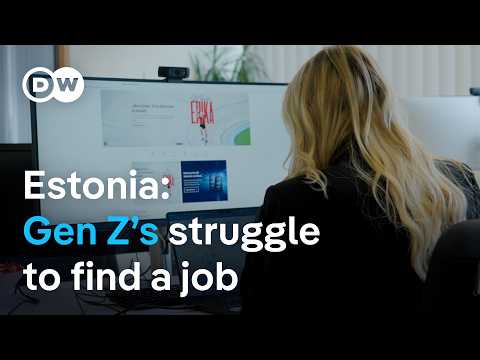
For decades, the deal was supposed to be fairly simple: study, graduate, get a junior job, make a few harmless mistakes while somebody more senior sighs heavily nearby, then gradually become useful. That first step is now wobbling.
In Estonia, a country celebrated for digital government, fast-growing tech companies and a startup scene far larger than its population might suggest, young people are finding that a degree does not automatically unlock the office door. A DW News report follows Tallinn-based finance graduate Steven, who supports himself by selling clothes online while applying for banking work. The problem is painfully familiar: roles advertised as junior often still demand experience.
It is not just an Estonian frustration. Across Europe, the entry-level market is being squeezed by a collision of slower hiring, changing employer expectations, automation and an education-to-work transition that too often resembles a rope bridge with several planks missing.
Estonia’s awkward labour-market contradiction
The figures cited in the DW report capture the paradox. Estonia’s overall unemployment rate stood at 6.6% in the second quarter of 2026, while youth unemployment was reported at above 20%. The national economy may not look like a catastrophe from 30,000 feet; for many young jobseekers on the ground, however, the runway has vanished.
That gap matters because Estonia is frequently portrayed as Europe’s digital success story. It is home to major technology businesses including Bolt and Wise, and the report notes that the country has produced ten “unicorn” companies. Yet a flourishing innovation brand does not guarantee a generous supply of first jobs for local graduates.
Some high-growth employers recruit internationally because they need experienced specialists in particular fields. Meanwhile, the candidates who need training most are competing for a small number of openings designed to require as little training as possible. It is an efficient arrangement only if one ignores the awkward question of where tomorrow’s experienced workers are meant to come from.
The experience trap has become a career tollbooth
Employers have understandable reasons to value proven experience. Hiring takes time, mentoring costs money and a poorly matched recruit can create headaches that spread through a small team like a bad office cold. But when nearly every “entry” role asks candidates to arrive already productive, the market creates a circular test: no experience without a job, no job without experience.
The effect is especially sharp in white-collar sectors. A finance graduate may possess theoretical knowledge but lack familiarity with internal systems, regulated workflows, client communication or the unglamorous spreadsheet rituals that make organisations function. Those are teachable skills. The question is whether companies still consider teaching them part of the bargain.
For graduates, this makes the label on a vacancy less useful than the actual requirements. A job called “junior” may still seek one or two years of relevant work, a portfolio, specialist software knowledge and evidence of commercial experience. None of that is inherently unreasonable. Taken together, it can turn a first role into a vacancy for someone who has already had a first role elsewhere.
AI is removing some of the old training ground
The shift is not solely about cautious recruiters. As an Estonian telecoms recruiter told DW, many classic entry-level tasks were repetitive: processing information, producing straightforward drafts, handling routine customer queries or performing basic administrative work. Automation and artificial intelligence can now handle parts of that workload faster and at lower cost.
That does not mean machines have abolished junior workers. It does mean businesses may hire fewer people to do the basic tasks through which previous generations learned how a workplace operates. The danger is not merely fewer jobs; it is fewer learning jobs.
Companies that adopt new tools without redesigning development pathways may save on headcount today and encounter a skills shortage tomorrow. Senior staff do not materialise from a cloud server. They are usually built through supervised practice, awkward early drafts, repeat questions and gradually more difficult work—the human version of software updates, except with more coffee.
Europe’s apprenticeship lesson
The DW report places Estonia’s challenge beside a wider European pattern, noting youth unemployment above the EU average even in some affluent countries. Wealth alone is not a reliable shield. The design of the school-to-work transition matters enormously.
Germany and the Netherlands are often singled out for stronger dual apprenticeship systems, which combine employer-based training with classroom instruction. These models are not magic wands, and they require committed employers, functioning schools and qualifications that workers can carry across their careers. But they offer a clearer route from education into paid, practical experience.
For countries trying to improve entry-level access, the useful lesson is broader than copying another nation’s scheme word for word. Young people need credible ways to acquire experience before they are expected to compete for permanent roles. That can include paid placements, apprenticeships, structured graduate schemes, work-integrated degrees and short conversion programmes built with employers rather than in isolation from them.
Unpaid internships, by contrast, are a poor substitute. They can deepen inequality by favouring candidates whose families can subsidise a period of low or no income. A labour market should not require an inheritance just to get a foothold.
Language, flexibility and the expectations gap
Estonia has an additional barrier for some applicants. The report highlights the experience of Varvara, an Estonian-born jobseeker with Russian roots who is not fluent in Estonian. She says language requirements have become more common, with many jobs requesting at least B1-level Estonian. Language skills can be essential for serving customers, working safely and participating fully in a workplace. But where they are required for roles that do not genuinely need them, they can narrow the candidate pool further.
There is also a clash of expectations. Younger workers frequently place a high value on flexibility and personal time; employers may interpret that as limited commitment, while younger applicants may see rigid workplace rules as a relic that should have been archived with the fax machine. Neither side benefits from caricatures.
Employers that offer clear development, predictable expectations and genuine flexibility may have an advantage in attracting young talent. The Estonian telecoms company Elisa, for example, told DW that 22% of its local workforce is from Generation Z, with staff working across sales, customer service and IT. That is a reminder that entry routes still exist—but they need to be deliberately maintained.
What graduates and employers can do next
Jobseekers cannot fix a structural problem with a better LinkedIn banner, but they can improve their odds. The most useful approach is to treat early experience as something that can be assembled from several sources, not only a perfect first permanent job.
- Read beyond the job title: identify the three or four skills that recur in vacancies and build evidence around them.
- Make practical work visible: coursework, volunteer projects, freelance assignments, student societies and personal projects can demonstrate reliability and applied skill when presented honestly.
- Use targeted training: language courses, industry certificates and software training are most valuable when connected to a realistic job target, not collected like digital souvenirs.
- Apply sideways, not only upwards: customer operations, support, sales coordination and administration can provide a route into sectors such as finance or technology.
Employers, meanwhile, should audit their so-called junior roles. If a vacancy requires prior experience, advanced technical expertise and immediate independence, it may be a mid-level job wearing a cheaper name badge. Paying for structured training, pairing recruits with mentors and judging candidates on potential as well as polished experience are not charitable gestures. They are workforce planning.
Europe’s youth employment problem will not be solved by telling graduates to try harder, nor by telling employers to lower every standard. The more durable answer is to restore the missing bridge between learning and earning—before a generation discovers that the career ladder begins two rungs above the ground.