
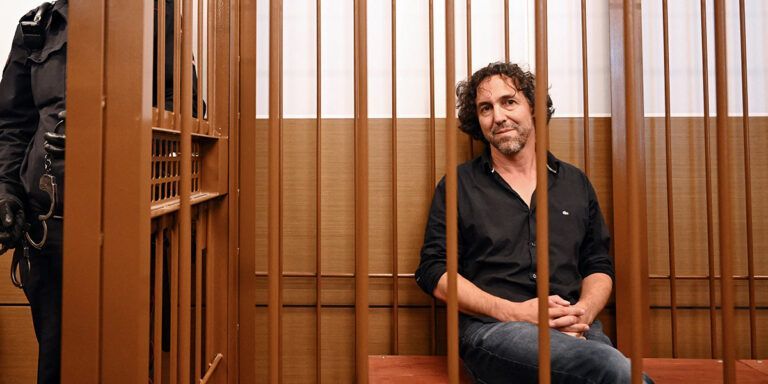
In what feels like a plot twist from a Cold War thriller nobody asked for, Laurent Vinatier, a French political scholar and self-proclaimed lover of Russian literature, found himself behind bars in Moscow. His crime? Not a sinister espionage scheme, but a classic case of “failing to register as a foreign agent” while gathering military info for his research. That’s right: academia just got a lot more dangerous in Putin’s Russia.
On Monday, Vinatier, 48, stood in a Moscow courtroom, staring through the bars of the defendant’s cage—because, of course, Russian courtrooms still feature literal cages. He had been convicted of collecting military information that could, as prosecutors melodramatically claimed, be «used to the detriment of Russia’s security.» His fate? A three-year stint in a Russian prison, with a side of Pushkin poetry for good measure.
A Scholar’s Fall from Grace—or Straight Into the Gulag?
Vinatier’s academic career had long centered on Russia. Twenty years ago, he fell in love with the country while studying its politics and culture. Love can make you do some crazy things, but in Vinatier’s case, it landed him in a cage in Zamoskvoretsky District Court. His lawyers, pleading for leniency, pointed out that Vinatier had been nothing but a friendly scholar, writing about Russia with all the love one reserves for Dostoevsky’s darkest novels. In the spirit of classic Russian drama, Vinatier even quoted Alexander Pushkin in court, offering a verse about patience and hope for better days.
It didn’t work. In a courtroom that seemed more interested in keeping foreign noses out of its business than appreciating poetic musings, Vinatier was handed a three-year sentence. His lawyers had asked for a fine, but the court wasn’t having it. Apparently, quoting Pushkin doesn’t get you a “get out of jail free” card in Moscow.
The «Foreign Agent» Law: Spies or Scholars?
Vinatier’s crime? Failing to register under Russia’s “foreign agent” law, a piece of legislation that, on the surface, might sound like something from a cheesy James Bond knockoff. The reality is far less glamorous. The law, widely criticized by human rights groups, forces anyone involved in gathering information on sensitive topics—especially military matters—to register as a foreign agent. And if you don’t, well, enjoy your cage.
Vinatier’s activities took place between 2021 and 2022, during which he allegedly collected military data from Russian citizens. But rather than donning a trench coat and snapping secret photos in shadowy alleys, Vinatier likely just met with people over cups of tea or coffee. The charge itself, prosecutors claim, could have landed him in prison for up to five years. However, his admission of guilt and cooperation with investigators shaved some time off his eventual sentence.
Moscow’s Spy Catching Frenzy
Vinatier’s case is just the latest in a string of detentions where Russia accuses foreigners of espionage. Since Moscow’s full-scale invasion of Ukraine in February 2022, the Kremlin has been on high alert, like a cat convinced it saw a shadow. Any foreigner with an interest in Russia’s military—whether they’re journalists, researchers, or just curious travelers—now risks getting caught in the dragnet. And if you’re French, like Vinatier, you might find yourself in even hotter water.
Tensions between Russia and France have been bubbling for some time. French President Emmanuel Macron, never one to mince words, has publicly flirted with the idea of deploying French troops to Ukraine, much to Moscow’s fury. Vinatier’s arrest, while officially about collecting military information, could well be part of a larger game of political chess. And in Russia, it seems, the pawns tend to get locked up.
Pushkin, Patriotism, and a Plea for Clemency
In an almost surreal scene, Vinatier, dressed for court like a man preparing for a final lecture on Russian poetry, addressed the court in fluent Russian. “I ask the Russian Federation to forgive me for failing to observe Russian laws,” he said, his voice betraying a mix of fear and frustration. It was a humble plea from a man who had once viewed Russia as a second home, a place of intellectual and cultural fascination. But Moscow didn’t seem in a forgiving mood.
Vinatier’s career had been built on studying the country he was now imprisoned in. As an adviser for the Swiss-based NGO Centre for Humanitarian Dialogue, he had spent years trying to understand Russia. Perhaps, in some tragic irony, he now understands it better than most Western scholars ever will.
Is the Sentence Overkill?
Three years in a Russian prison might seem harsh for a man whose only real crime was academic curiosity. Vinatier’s lawyers argued as much, pointing to his work as evidence that he was no threat to the Russian state. After all, how many spies go around publishing pro-Russian articles and quoting Pushkin?
But in Putin’s Russia, the line between scholar and spy has never been thinner. And as Vinatier learned the hard way, crossing it—whether knowingly or not—can land you in a cage, staring out at the cold, Kafkaesque machinery of Russian justice.
Let’s just hope Vinatier has more Pushkin memorized. He’s going to need it.