
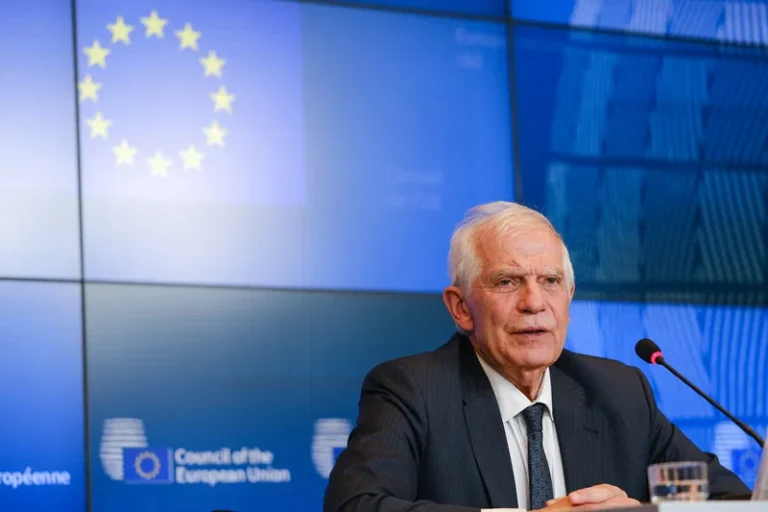
In a diplomatic rant that would make your family’s Thanksgiving arguments look tame, Josep Borrell, the EU’s top foreign policy chief, lamented the “painful lack of unity” among the 27 EU members regarding the ongoing Gaza war. Apparently, getting Europeans to agree on Middle Eastern policy is as impossible as deciding on the perfect temperature for croissants—it’s just not happening.
A House Divided: EU’s Dysfunctional Foreign Policy
Borrell’s latest frustration stems from the inability of EU member states to present a united front in the face of the Gaza conflict. His message is simple: while Israel and Hamas are tearing each other apart, the EU is too busy bickering to make a meaningful impact. The European Union’s foreign policy, once imagined as a force for peace and diplomacy, is now looking more like a dysfunctional group chat where nobody can agree on anything, except maybe the fact that coffee is better in Italy.
Borrell himself has been desperately trying to broker some semblance of a peace plan, pushing for the ever-elusive “two-state solution.” But the EU, much like your most annoying colleague, keeps showing up to the meeting unprepared, with no real consensus on what to do next. According to Borrell, this lack of unity is not just embarrassing, but it’s actively undermining Europe’s ability to wield influence on the global stage.
Israel, Hamas, and Europe’s Seat at the Kids’ Table
While Israel is busy flexing its military muscles and Hamas continues to fire rockets, the EU is over in the corner, shuffling papers and wondering if anyone will even notice they’re there. Borrell pointed out that the EU’s disjointed stance has left it sidelined in one of the world’s most pressing conflicts. If Europe were a dinner party, Israel and the U.S. would be sitting at the adults’ table making all the decisions, while the EU squabbles in the kitchen over who forgot to bring dessert.
The EU’s internal divisions are only worsened by the fact that member states can’t agree on what role to play in the conflict. Countries like Spain and Ireland have been vocal critics of Israel’s military actions, while others—namely Germany—are much more reserved, fearful of stepping on historical landmines. Germany’s complex relationship with Israel makes it reluctant to condemn the country too harshly, leaving the EU with a moral dilemma as murky as a glass of day-old sangria.
The Borrell Plan: Diplomacy or Daydream?
Despite the chaos, Borrell has remained committed to pushing his peace plan, based on the two-state solution, even though everyone seems to be treating it like the world’s least exciting reality TV show—nobody’s tuning in. It’s a noble effort, but one that feels increasingly out of touch with the grim realities on the ground. Borrell’s critics argue that the EU’s lack of cohesive action has rendered it little more than a spectator in this bloody spectacle, watching helplessly as Israel and Hamas duke it out.
Meanwhile, Borrell’s public criticism of Israel has earned him some side-eye from Israeli officials, who aren’t exactly known for taking kindly to international scoldings. Israel’s Prime Minister Benjamin Netanyahu, notorious for his diplomatic bluntness, has already brushed off Borrell’s concerns like lint on his suit. After all, with backing from the U.S. and quiet support from other key players, Israel isn’t exactly shaking in its boots over what Brussels thinks.
Can Europe Get Its Act Together?
The underlying problem here is clear: the EU’s dreams of being a global diplomatic power are being shattered by its own member states’ inability to agree on anything. With no consensus on how to handle the Israel-Hamas conflict, Europe is losing credibility fast. And as Borrell rightly points out, this isn’t just a moral failure—it’s a strategic one. If the EU can’t come together on a major issue like Gaza, how can it hope to maintain its influence on other global matters?
As Gaza burns and Borrell’s patience wears thin, it’s becoming clear that Europe’s biggest enemy isn’t just its geographic neighbors—it’s itself. The EU’s house is divided, and unless its leaders can find a way to patch things up, they’ll continue to watch from the sidelines as the real players decide the fate of the Middle East.
For now, Borrell remains Europe’s diplomatic punching bag, left to clean up the mess while his bosses argue over who gets to sit at the big table.